
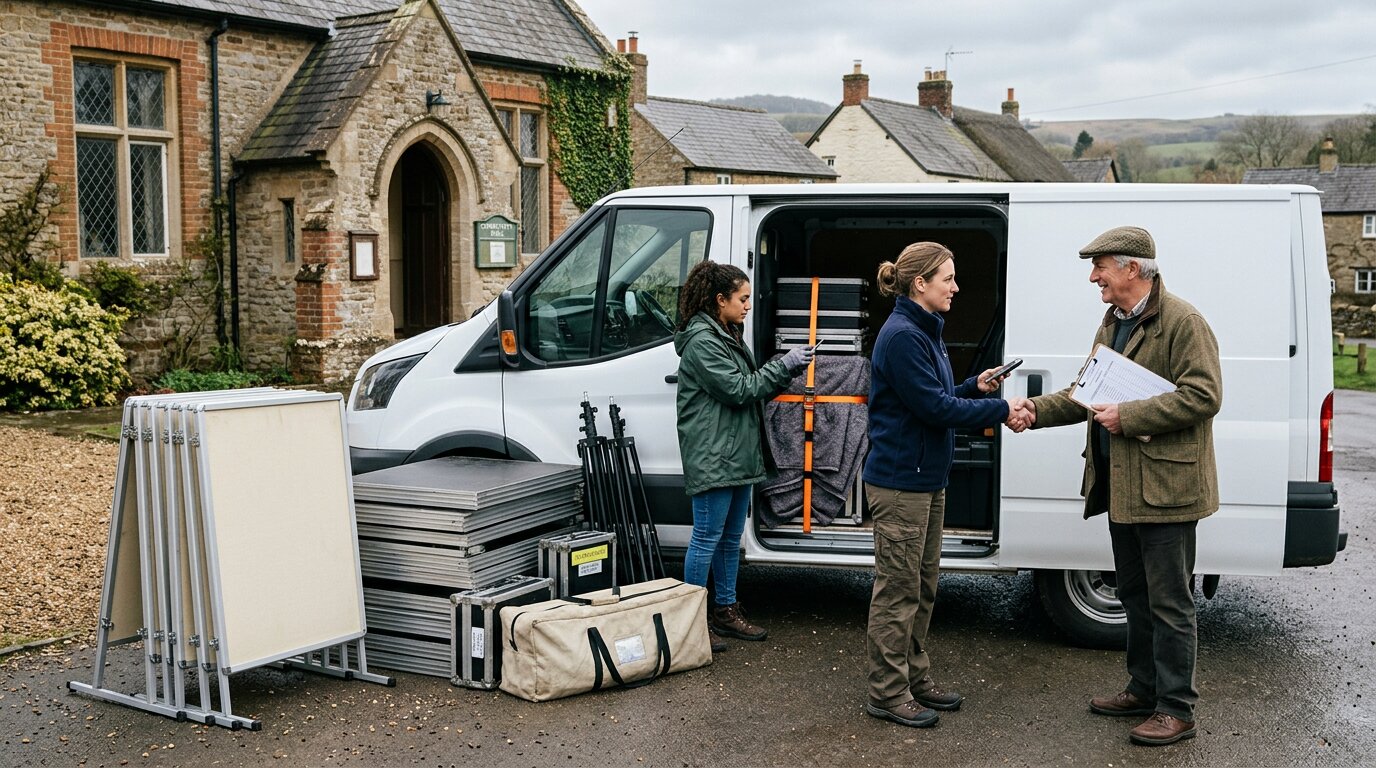
Cultural events run on borrowed things. An arts trail borrows display boards from a school. A folk evening borrows a staging set from a sister group two counties away. A heritage open day borrows lighting stands and a marquee from a club that happens to have a spare. Very little of it is paid for. It is lent on trust, by people who would like it back on time, dry and complete.
That trust is worth more than the kit. Collecting borrowed equipment is a favour. Returning it late, damp or a pole short is how favours quietly stop. So the most useful habit is simple to describe and easy to skip: agree what you are borrowing, when it moves and who is responsible for it, in writing, before anyone drives anywhere. The questions below cover the practical side. They are not legal advice, and anything formal, such as insurance or a written loan agreement, should be checked with the lender and your own group’s insurer.
What exactly are we borrowing?
Ask the lender for a list, and check it against what actually comes off the shelf. “Six display boards” can mean six panels, twelve feet, a bag of connecting clips and two carry cases, and it is always the clips that go missing. Note quantities, sizes and anything fragile or heavy. Staging decks, for instance, are often heavier than they look and need two people each.
Ask too whether the lender has conditions. Many community lending schemes expect items back by an agreed date in their original condition, and make the borrower responsible for loss or damage. Llantrisant Community Council’s equipment loan form, for example, asks borrowers to return items by the agreed date in their original condition and to report theft, loss or damage as soon as possible (loan form, PDF). Expect something similar from any careful lender, and treat it as a sign they look after their kit.
When can it be collected, and when must it be back?
Lenders often have narrow windows: a school office open on weekdays only, a caretaker who can let you in on a Thursday evening. Pin down both ends before you book any vehicle. If the event is on a Saturday and the lender only opens on weekdays, the equipment may be with you from Friday to Monday, and you need somewhere dry and secure to keep it in between.
Do we need a van, and where should we hire it?
If the items fit in two volunteers’ cars, use the cars. If there are long poles, staging decks or more than a couple of car-loads, a van with one named driver is usually simpler, and kinder on the volunteers.
Hire close to where the work is. If your collection is around south Hertfordshire, you can check van availability in Borehamwood, where the page lists small vans up to Luton tail-lift and dropside types. Ask for the exact vehicle, its load length and payload, the deposit and the insurance excess.
What if the lender is much further away?
Sometimes the equipment is coming from another region altogether, such as a group in Hampshire. In that case it can make more sense to arrange the van at that end, collect, deliver and drop off in one loop, rather than driving an empty hired van across several counties. For collections around east Hampshire, there is van hire information for Alton. Confirm whether one-way hire or a different return point is possible before you plan around it, and do not assume delivery to a distant address.
Who can drive the van?
Check licences before the day, not at the hire desk. A standard category B car licence covers vehicles up to 3,500kg maximum authorised mass for petrol and diesel, according to GOV.UK’s licence categories page. Confirm the plated weight of the van you are offered. Only the named driver should drive it, however many helpers offer to take a turn.
How do we record the condition of what we borrowed?
Use a simple collection record. Fill in the “out” columns with the lender at collection and the “back” columns at return. Both of you keep a copy or a photo.
| Item | Qty | Condition out (notes, photo ref) | Collected by / date | Condition back | Returned by / date | Lender initials |
|---|---|---|---|---|---|---|
| e.g. display boards with feet and clips | 6 | One panel scuffed on lower edge, photo 1 | ||||
| e.g. staging decks | 4 | Good | ||||
A lending-agreement checklist (not legal advice)
- Itemised list agreed with the lender, including small parts, clips and bags.
- Collection and return dates, times and addresses.
- Who is responsible for the items while they are with you.
- What happens if something is lost or damaged, and who pays.
- Whether the lender’s or your group’s insurance covers the items in transit and at the event. Ask both.
- Any rules on use, such as no lending on to a third party.
- Cleaning expectations: dry, clean, packed the way it came.
- A named contact at each end with a phone number.
What should happen on the return trip?
Dry anything canvas before it goes back. Load in the reverse order of drop-off. Before driving, check the load cannot shift: GOV.UK’s van walkaround guidance says to check that any load does not move and is not likely to move.
Then hand the equipment over in person, go through the record together, and get the lender’s initials. A short thank-you note, or a mention in the event programme, costs nothing. That last signature, and the thanks that goes with it, is what makes a lender say yes again next year.