
Key takeaways
- Keep two lists: people and equipment. They travel separately.
- The longest item decides the van length; the heaviest decides whether you need a tail lift.
- A vehicle plated at no more than 3,500kg can be driven on an ordinary car licence. Above that, someone needs category C1.
- Name the driver for the return trip before you book, not after.
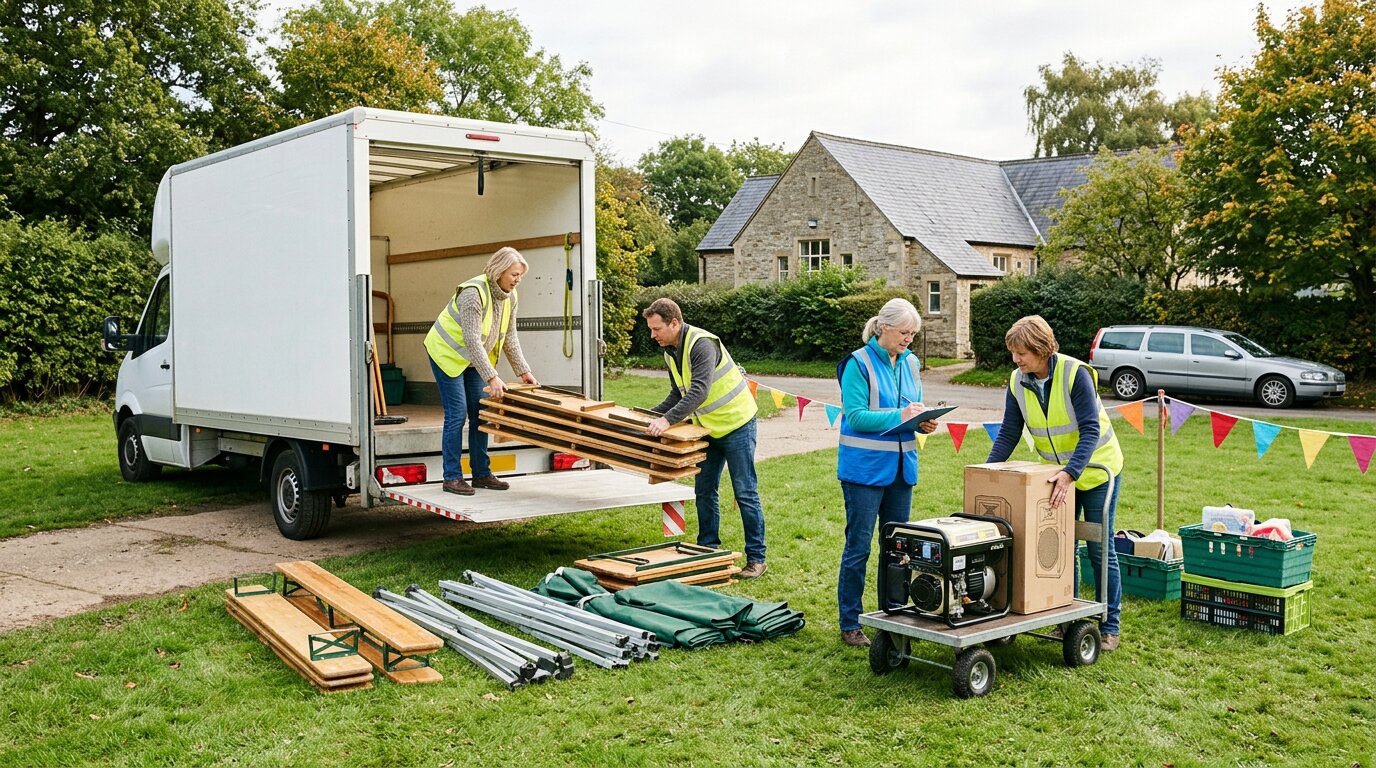
A village fair or a small cultural festival tends to get planned around the fun parts: the stalls, the music, the craft tent, the raffle. Transport arrives late in the conversation, usually as “someone’s got a big car, haven’t they?” Most local events need one vehicle run, maybe two: tables and benches on Friday, a gazebo or two, the tea urn, the PA, then everything back on Sunday. A large panel van or a Luton with a tail lift usually covers that, and if the vehicle is plated at no more than 3,500kg it can be driven on an ordinary car licence.
The point where a van stops being enough is easier to spot than people think. It comes when the equipment won’t fit in one or two trips, when a single item is too heavy to lift safely, or when the load needs a vehicle over 3,500kg and nobody on the committee is licensed for it. The plan below helps a committee work that out early, before someone volunteers their own estate car and a lot of goodwill.
Keep people and equipment on separate lists
Start with two lists, not one. The first is people: helpers who need to get to the site, and anyone who can’t drive themselves. The second is equipment. They go in different vehicles. Nobody rides in the back of a van with the tables, and a panel van’s or Luton’s cab seats are the only passenger places it has. If helpers need moving, that’s car sharing or a passenger vehicle, planned on its own.
Measure the equipment, roughly but honestly
For each item on the equipment list, note:
- how many there are (trestle tables, benches, gazebo frames)
- the longest dimension, folded
- whether two people can lift it comfortably
- where it is collected from and where it goes
Long items, such as marquee poles, staging sections and folded tables, decide the van length. Heavy items, such as generators, catering equipment and staging decks, decide whether you need a tail lift. If a hall, school or club is lending equipment, ask the booking contact for sizes rather than guessing from memory. Halls that hire out tables and chairs will usually know the folded dimensions, and it takes them a minute to tell you.
The vehicle-choice decision tree
- Does everything fit in the cars of willing volunteers, in one trip, without blocking anyone’s view or seatbelts?
- Yes: use cars. Load heavy items low and secure them.
- No: go to 2.
- Is the longest item under about three metres, and can two people lift every item?
- Yes: a large panel van is likely enough. Go to 4.
- No: go to 3.
- Is the problem weight or bulk rather than length?
- Weight or bulk: ask for a Luton or box van with a tail lift. Go to 4.
- Length (long poles, staging): ask about a longer van or a dropside. Go to 4.
- Does the vehicle’s maximum authorised mass stay at or under 3,500kg?
- Yes: a driver with a standard category B licence can drive it (see below). Go to 5.
- No: you need a driver with category C1, or a supplier who delivers, or a smaller vehicle doing two trips.
- Is there a named, insured driver for both the collection and the return?
- Yes: book it.
- No: fix that before booking anything.
The three-metre figure in step 2 is a rule of thumb for a starting conversation, not a specification. Ask the hirer for the load length of the actual vehicle.
Check driver and access requirements
GOV.UK’s licence categories page says a category B licence covers vehicles up to 3,500kg maximum authorised mass for petrol and diesel, and category C1 covers 3,500kg to 7,500kg. Many hire Lutons and large vans are plated at 3,500kg, but check the plate on the vehicle you’re given. A 7.5-tonne truck is outside category B.
Whatever the size, the load has to be secured. The Highway Code’s rule 98 says you must not overload the vehicle and must secure the load. The DVSA’s guidance on loading vans adds that items shouldn’t be stored in the cab, so the urn doesn’t ride on the passenger seat.
Then walk the site. Where does the vehicle stop to unload? Is there a soft verge that will be mud by Saturday? Will the van be stuck on the field once stalls are up? Agree an unloading point and a time the vehicle has to leave.
Two regional examples
The two examples below are from different parts of England and aren’t tied to any particular village or event. They are included only to show the kind of questions worth asking, wherever you hire.
Example 1: a van for a north Nottinghamshire event
Website: van hire information for Worksop
Area stated on the site: Worksop, Retford and surrounding areas.
What to ask: load length of the specific van, whether a tail lift is available, delivery and collection to the event site, named-driver rules, and the return time on a Sunday or Monday.
Example 2: a truck for a larger Oxfordshire event
Website: vehicle availability in Oxford
Area stated on the site: Oxford, Oxfordshire. The page lists 3.5-tonne tippers and 7.5-tonne box and curtain-side trucks.
What to ask: whether a vehicle within category B (3,500kg) would do the job, the licence required for anything larger, tail-lift capacity and delivery arrangements. If the event is in the city centre, ask about access restrictions and emission rules.
Create a handover sheet for volunteers
Events rarely fail on the day. They fail at 9am on Monday when nobody is sure who has the keys. One sheet, shared with the committee, avoids that.
| Task | Named person | When | Done |
|---|---|---|---|
| Book vehicle and confirm insured drivers | At least two weeks before | ☐ | |
| Collect vehicle, photograph damage and fuel level | Friday | ☐ | |
| Load at the store, check every item against the list | Friday | ☐ | |
| Unload at site, move vehicle off the field | Friday / Saturday | ☐ | |
| Reload after pack-down, count items again | Saturday / Sunday | ☐ | |
| Return items to the hall and other lenders | Sunday / Monday | ☐ | |
| Refuel, sweep out, return vehicle, keep the receipt | By the agreed time | ☐ |
A hypothetical example: a village fair with twenty trestle tables, a dozen benches, three gazebos and a generator. Two people can lift everything except the generator, and nothing is longer than the folded tables. One Luton with a tail lift, plated at 3,500kg and driven by a committee member with a car licence, does the Friday run and the Sunday return. That’s two trips, one vehicle and no need for anything bigger. Isn’t that a better use of a volunteer’s Friday evening than three trips in a hatchback?